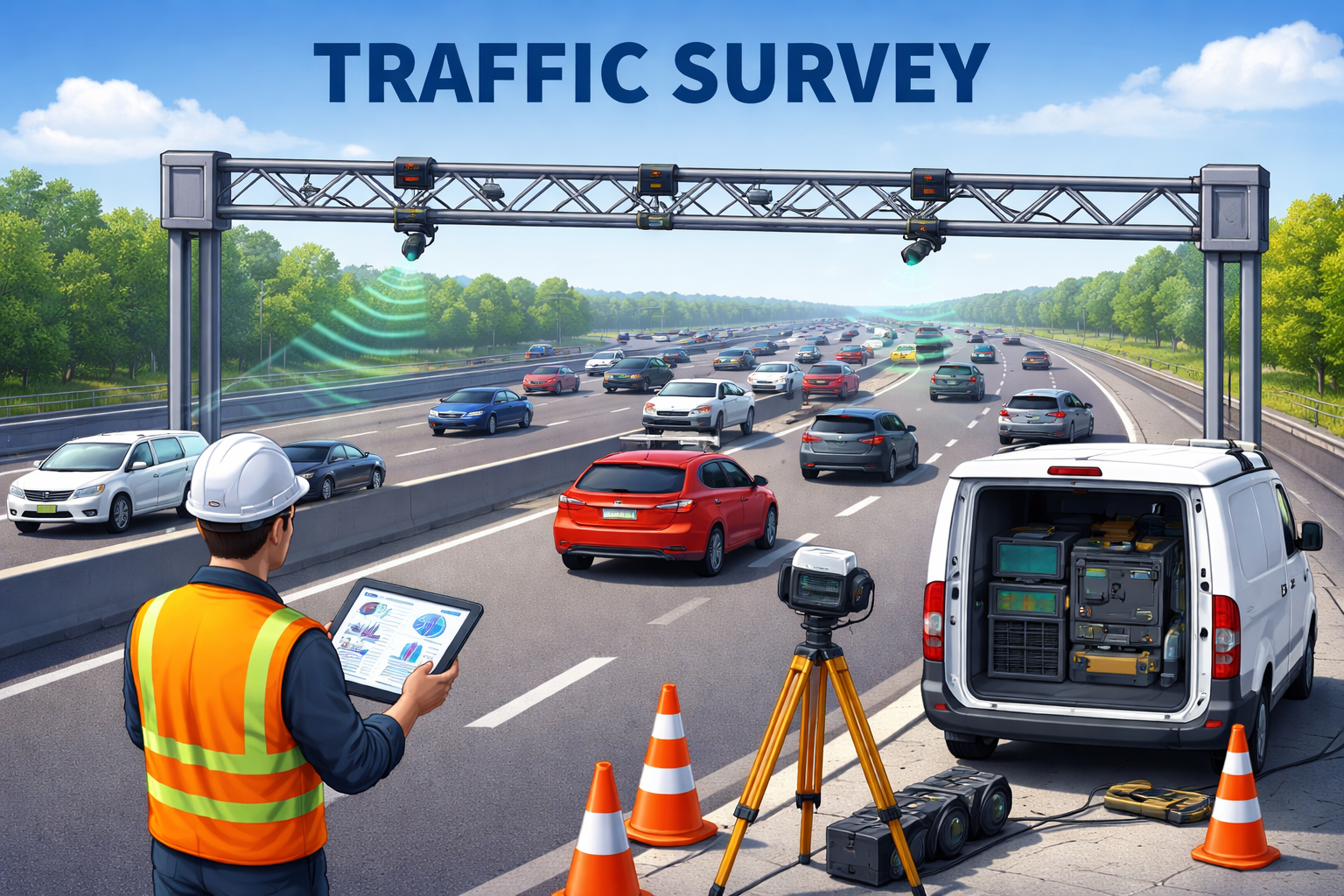
Traffic Survey: A Complete Guide to Understanding Road Usage

traffic-survey

Traffic Survey: A Complete Guide to Understanding Road Usage

Efficient transportation systems are the backbone of modern cities. Whether it’s reducing congestion, planning new roads, or improving safety, accurate data is essential—and that’s where a traffic survey comes in.

A traffic survey is a systematic method of collecting data about vehicles, pedestrians, and overall road usage. This information helps engineers, planners, and policymakers make informed decisions to improve mobility and infrastructure.

What is a Traffic Survey?

A traffic survey involves gathering detailed information about how roads are used. It measures factors like:

  • Traffic volume (number of vehicles)
  • Speed of vehicles
  • Travel time and delays
  • Vehicle classification (cars, trucks, buses, etc.)
  • Pedestrian movement

The goal is to understand traffic patterns and identify issues such as congestion, unsafe intersections, or inefficient road design.

Types of Traffic Surveys

1. Traffic Volume Survey

This is the most common type. It counts the number of vehicles passing a point over a specific period. It helps determine peak hours and road capacity.

2. Speed Survey

Measures how fast vehicles travel on a road. It is useful for setting speed limits and identifying unsafe driving behavior.

3. Travel Time and Delay Survey

Analyzes how long it takes to travel between two points and where delays occur. This is essential for improving traffic flow.

4. Origin-Destination (O-D) Survey

Tracks where trips begin and end. It helps planners understand movement patterns across a city or region.

5. Parking Survey

Studies parking demand, usage, and turnover to improve parking management.

6. Pedestrian and Bicycle Survey

Focuses on non-motorized traffic, helping create safer walkways and bike lanes.

Methods of Conducting Traffic Surveys

Manual Methods

Surveyors physically count vehicles or record data on-site. While simple, it can be time-consuming and prone to human error.

Automatic Methods

Modern surveys use advanced tools such as:

  • CCTV cameras
  • Radar sensors
  • GPS tracking
  • Mobile apps and AI-based software

These methods provide more accurate and continuous data collection.

Importance of Traffic Surveys

Traffic surveys play a critical role in:

  • Urban planning – Designing better road networks
  • Traffic management – Reducing congestion and improving flow
  • Road safety – Identifying accident-prone areas
  • Infrastructure development – Planning highways, bridges, and intersections
  • Policy making – Supporting data-driven transportation policies

Benefits of Traffic Surveys

  • Helps reduce traffic congestion
  • Improves road safety and efficiency
  • Supports sustainable transportation planning
  • Saves time and fuel for commuters
  • Enhances overall urban mobility

Challenges in Traffic Surveys

  • High cost of advanced equipment
  • Data accuracy issues in manual surveys
  • Weather and environmental factors
  • Need for skilled data analysis

Conclusion

A traffic survey is a powerful tool for understanding how roads are used and how they can be improved. As cities continue to grow, the need for accurate traffic data becomes even more important.

With the integration of modern technology, traffic surveys are becoming faster, smarter, and more reliable—helping create safer and more efficient transportation systems for everyone.

Recent Posts

utlity-survey

Utility Survey: A Complete Guide to Mapping Underground Services

March 31, 2026

Side Scan Survey: A Complete Guide to Mapping the Seafloor

March 30, 2026

What is a GIS Survey, and Why Does It Matter?

March 30, 2026

Need Help Right Away?

Call Us Now!

+8801961215160

Email Us Now!

contact@escosurvey.com

Share with your community!